
State Drainage Issue · 350 Randolph Road · Middletown, CT

90 Years.
Their Pipes.Our Land.

The Connecticut DOT has been dumping stormwater onto Lovie's Farm since 1933 — and the law lets them keep doing it forever. This is not just our fight. It's a fight for every landowner in Connecticut.

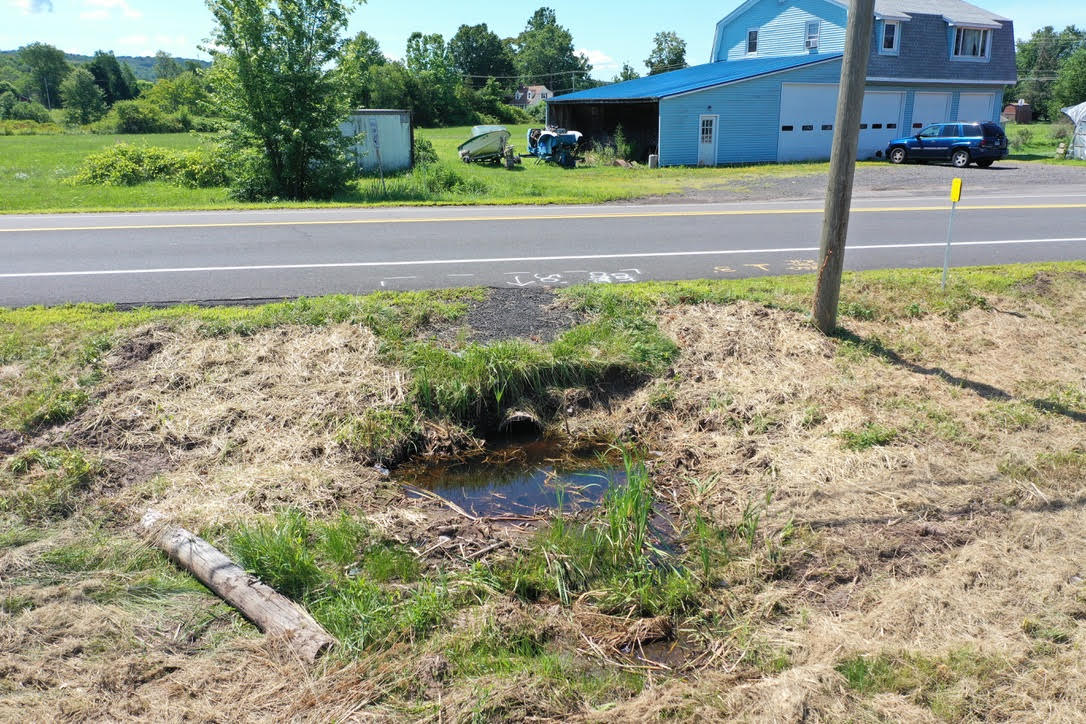
State stormwater culvert outlet on Lovie's Farm property, Middletown CT
Photo: Culvert Outfall · 350 Randolph Rd

State DOT confirmed in writing: they have "adverse possession right to drain" onto our private farmland — with no legal obligation to stop.

Read Their Response →
What Happened

State Road Runoff.
Private Land. No Consent.

Two reinforced concrete culvert pipes — an 18" and a 24" RCP — were installed beneath Route 155 in Middletown during state road construction in 1933. They were deliberately engineered to discharge stormwater northward onto what is now Lovie's Farm.

The state built them, mapped them, and has maintained this arrangement for 90 years. Our entire 13.4-acre property sits within the FEMA floodplain. Every time it rains, state road runoff flows directly onto our land — flooding fields, saturating soil, and constraining everything we try to build here.

When we formally asked the Connecticut DOT what could be done, they sent a letter confirming it all — and explaining why they don't have to change a thing.

90

Years of Uninterrupted Drainage

Both culvert pipes have discharged stormwater onto this land every rain event since 1933 — without compensation, easement, or remedy.

13.4

Acres in the FEMA Floodplain

The entire property sits within the FEMA-designated floodplain. State-directed runoff compounds the natural flood risk on every acre we farm.

$0

Compensation Ever Paid

No easement was purchased. No compensation has ever been offered. The state simply took the drainage right — and the law rewards them for it.

Stormwater culvert outfall pooling on Lovie's Farm property
On-Site Evidence

This Is What 90 Years Looks Like

This is the culvert outfall on our property — visible, unmistakable, and permanent unless we bear the full engineering and construction cost to redirect it ourselves.

The state's own 1933 construction maps document these pipes. Their 1939 Right of Way map shows them discharging northward. A 2024 aerial still shows the brook that runs through our land, shaped in part by nine decades of state-directed flow.

The Paper Trail

A 90-Year Record They Left Behind

1933
Construction Project 0082-0010 · State Highway Department

The Pipes Are Installed

During Route 155 construction, the state installs an 18" RCP west of Bridge #05379 and a 24" RCP east of it — both designed to carry stormwater south-to-north directly onto adjacent private land. No easement purchased. No compensation paid.

1939
Official State Right of Way Map · Feb. 28, 1939

Documented on Official State Record

The Connecticut State Highway Department's official Right of Way map — surveyed by state engineers, signed by the Commissioner — shows both culvert pipes discharging northward onto private property. The state knew. They mapped it. They signed it.

2024
Present Day · 350 Randolph Road · Middletown, CT

The Water Still Flows — Onto Lovie's Farm

Today this land is Lovie's Farm — 13.4 acres of regenerative farmland named for four-year-old Sienna "Lovie" Mitchell. The same two pipes continue to discharge road runoff onto the property. Nothing has changed in 90 years.

Feb
'24
CT DOT Response · Customer Care #41200 · Feb. 29, 2024

The State's Answer: We Don't Have To Change

District Drainage Engineer Monique Burns responds in writing — confirming both pipes, confirming the discharge onto our property, and concluding that under CGS §13a-138 and adverse possession drainage rights, after 90 years the state has the permanent legal right to continue. No remedy owed.

Direct from CT DOT — Customer Care #41200 — Feb. 29, 2024

"Our legal agency deems the Department has adverse possession right to drain by the evidence provided here showing that these two pipes have existed in their current location conveying storm water under Rte. 155 uninterrupted open and notorious for more than 15 years (90 years to date)."

— Monique Burns, District Drainage Engineer · CT DOT Bureau of Highway Operations

The state is not disputing the facts. They are not claiming the drainage is harmless. They are asserting that because they have done it long enough, they now have the permanent legal right to keep doing it — and that any remedy must be fully designed and engineered at no cost to the State.

This is not an oversight. This is not an accident. This is official Connecticut policy — and it is being applied to landowners across this state right now.

The Broken Law

CGS §13a-138: Written to Protect the State, Not the People

Connecticut General Statute §13a-138 authorizes highway authorities to drain stormwater "into or through any person's land so far as necessary." A companion statute, §13a-138a, imposes a 15-year statute of limitations — meaning once 15 years pass, landowners permanently lose the right to seek damages.

These pipes were installed in 1933. By 1948, the window to challenge them had already closed forever. Every property owner since has inherited a permanent burden they didn't create, couldn't challenge, and can't undo without paying for it themselves.

CGS § 13a-138 (a)

"Persons authorized to construct or to repair highways may make or clear any watercourse or place for draining off the water therefrom into or through any person's land so far as necessary…"

CGS § 13a-138a — 15-Year Limitation

"No action shall be brought by the owner of land adjoining a public highway… for recovery of damage… but within fifteen years next after the first occurrence of such drainage…"

Problem 1 — The 15-Year Cutoff Must Go

The statute of limitations permanently bars any legal remedy once 15 years pass. For old infrastructure, this window closes before most owners ever know the problem exists.

Problem 2 — Adverse Possession by the State

The state uses a private-party legal doctrine to justify dumping highway runoff on private land indefinitely — no easement purchased, no compensation paid.

Problem 3 — Remediation on Your Dime

If a landowner wants to address the outfall, the state requires fully engineered plans — at the landowner's expense. The state caused it; you pay to fix it.

Problem 4 — This Affects Every Landowner

Thousands of Connecticut parcels may sit under this same doctrine. Most owners don't find out until they try to sell, develop, or — like us — simply ask what's on their land.

Our Demands

We're Calling for Real Change

This fight is not just about Lovie's Farm. It's about whether Connecticut law can impose a permanent, uncompensated burden on private citizens and walk away. We are asking legislators, neighbors, and our community to stand with us on four concrete reforms.

01 — Repeal the 15-Year Bar

Eliminate or fundamentally reform CGS §13a-138a's statute of limitations, which permanently strips landowners of any legal remedy — often before they even own the property.

02 — State-Funded Remediation Plan

Require CT DOT to inventory all highway drainage outfalls onto private land and develop a funded, time-bound remediation plan — paid for by the state that built the infrastructure.

03 — Fair Compensation Framework

Establish compensation for landowners bearing the cost of state-directed stormwater — including those already past the statutory window who have had no recourse for decades.

04 — Mandatory Disclosure at Sale

Require disclosure of state drainage conditions during real estate transactions so future buyers understand what they are inheriting before they sign.

This Is Bigger Than One Farm.

Add your voice. Contact your state legislator. Share this page. Help us change a 90-year-old injustice that is still happening today — to families across Connecticut.

Stay in the Fight

Get updates on this campaign and everything happening at Lovie's Farm.

Join Our Newsletter →